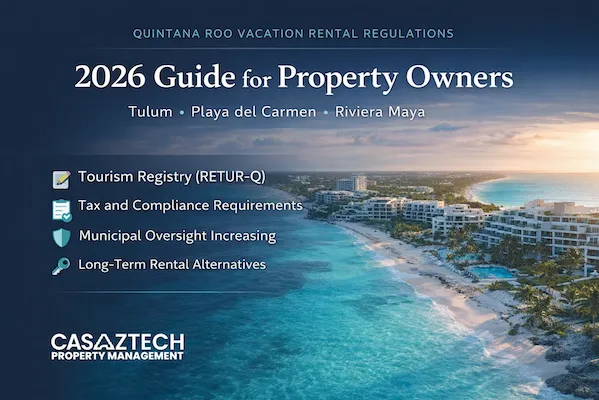
Quintana Roo's New Vacation Rental Regulations (2026 Update): What Property Owners Need to Know
Last Updated: March 2026
Over the past several years, short term rentals in destinations such as Tulum, Playa del Carmen, Cancun, and Akumal have expanded rapidly. Thousands of condominiums and homes have been listed on platforms like Airbnb and Vrbo as tourism accommodations.
During the early growth of the market, oversight of vacation rentals was relatively limited. Many investors purchased properties expecting that operating a short term rental would be straightforward.
That environment is now changing.
In recent years, the state of Quintana Roo and several municipalities have introduced regulatory requirements affecting tourism accommodations. Registration systems, tax compliance, and safety oversight are becoming more structured as the number of vacation rentals has increased.
Many property owners researching Airbnb regulations in Tulum and Playa del Carmen are only now discovering how these rules affect their rental operations.
If you own property in the Riviera Maya, understanding the regulatory environment has become increasingly important.
Property owners who are exploring alternatives to short term rentals can learn more about long term rental management here:
https://pm.casaztech.com/property-management
Quick Summary: Quintana Roo Vacation Rental Regulations (2026 Update)
Property owners operating short term vacation rentals in Quintana Roo must comply with several regulatory requirements. These rules apply across major tourism markets including Tulum, Playa del Carmen, Cancun, and the broader Riviera Maya.
Key requirements include:
• Registration in the RETUR-Q tourism registry maintained by the State of Quintana Roo
• Proper tax registration with SAT, Mexico’s federal tax authority
• Collection and reporting of lodging taxes and other applicable obligations
• Compliance with municipal licensing and local zoning requirements
These vacation rental rules in Quintana Roo have become increasingly important as enforcement expands across tourism destinations in the state.
Because the regulatory environment has become more structured, some property owners are reassessing whether short term rentals remain the most practical strategy for their property.
Long term residential rentals operate under a different legal framework and are generally not classified as tourism accommodations.
How These Regulations Affect Property Owners in Tulum and Playa del Carmen
While the regulatory framework applies across Quintana Roo, property owners in Tulum and Playa del Carmen are among the most affected due to the high concentration of vacation rental properties in these markets.
Both cities have experienced rapid growth in tourism accommodations over the past decade. As the number of listings increased, local governments began focusing more closely on compliance, safety standards, and municipal oversight.
Because these cities have some of the largest concentrations of short term rental listings in Mexico, enforcement of tourism accommodation regulations is likely to focus heavily in these areas.
Are Vacation Rentals Legal in Quintana Roo?
Vacation rentals are legal in Quintana Roo, but they are regulated as tourism accommodations.
Properties rented for short stays through platforms such as Airbnb or Vrbo may be subject to tourism registration requirements, tax obligations, and safety regulations administered by state and municipal authorities.
Owners operating vacation rentals should ensure they understand the applicable rules before offering accommodations to guests.
Tourism Registration Requirements (RETUR-Q)
One of the most important regulatory requirements affecting short term rentals in the state is registration with the RETUR-Q tourism registry, a system created by the Quintana Roo government to track tourism accommodations operating in the region.
Property owners can review the registry here:
https://sedetur.qroo.gob.mx/returq/
The tourism registry helps authorities:
• identify tourism accommodations operating in the state
• monitor compliance with tourism regulations
• enforce applicable safety and operational standards
The registry is administered by the Secretariat of Tourism of Quintana Roo (SEDETUR):
Failure to comply with tourism registry requirements may result in administrative penalties or restrictions on operating tourism accommodations.
Licensing and Tax Compliance
Short term rental income in Mexico is subject to several tax obligations.
Depending on how a property is operated, these may include:
• state lodging taxes
• VAT (IVA) on lodging services
• income tax (ISR) on rental income
While some rental platforms collect certain taxes automatically, property owners remain responsible for ensuring their tax obligations are handled properly.
Federal tax administration in Mexico is managed by the Servicio de Administración Tributaria (SAT).
Tax compliance has become one of the areas receiving increased attention as tourism accommodations continue to expand across Quintana Roo.
Municipal Regulations and Local Enforcement
Municipal governments such as Tulum, Playa del Carmen, Cancun, and Puerto Morelos may also establish regulations affecting tourism accommodations.
These regulations may involve:
• local operating permits
• zoning restrictions
• civil protection inspections
• penalties for non compliant tourism accommodations
As tourism activity continues to grow, municipalities are increasingly involved in regulating vacation rental operations.
Safety and Civil Protection Requirements
Vacation rental properties may also be subject to safety standards designed to protect guests.
Depending on the municipality, properties may be expected to comply with requirements such as:
• fire extinguishers
• smoke detectors
• safe gas installations
• emergency procedures for guests
Local authorities may conduct inspections to verify compliance with civil protection regulations.
The Difference Between Listing a Property and Operating Legally
One of the most common misunderstandings among property owners is the difference between listing a property on a rental platform and operating a compliant tourism accommodation.
Listing platforms do not verify whether a property is properly registered with tourism authorities or whether the owner is complying with tax and regulatory obligations.
Many hosts entered the market during the rapid growth of short term rentals and focused primarily on marketing the property to guests. Regulatory compliance and documentation were often treated as secondary concerns.
As enforcement increases, property owners are realizing that operating real estate assets requires a more structured approach.
Increasing Costs Are Reducing Short Term Rental Returns
Another factor affecting many vacation rental owners is the increasing cost of operating short term rentals.
Although nightly rates in destinations such as Tulum and Playa del Carmen may appear attractive, the actual return for owners can be significantly reduced by operational and regulatory costs.
These costs may include:
• lodging taxes
• federal tax obligations
• tourism registration requirements
• compliance with safety standards
• cleaning and operational expenses
• platform service fees
Some rental platforms have also adjusted their fee structures in ways that shift a larger portion of costs onto hosts and property owners.
As these expenses accumulate, many owners are finding that their net income is lower than originally expected. In other words, increasing regulatory burdens, taxes, and platform fees are putting pressure on ROI even when nightly rates appear higher.
What Is the Difference Between a Vacation Rental and a Long Term Rental in Mexico?
Vacation rentals are typically classified as tourism accommodations when properties are rented for short stays through platforms such as Airbnb or Vrbo.
Tourism accommodations may be subject to registration requirements, tax obligations, and safety regulations.
Long term residential rentals operate under a different legal framework. These rentals are governed by residential lease agreements rather than tourism regulations.
Because long term rentals are not classified as tourism accommodations, they are generally not subject to the same registration and licensing requirements.
While regulations vary across the country, short-term rental regulations in Mexico have become more structured in tourism heavy regions such as Quintana Roo.
Hosting vs Professional Property Management
Many companies that entered the market during the rapid growth of short term rentals focused primarily on hospitality operations and guest hosting.
These businesses often specialize in managing nightly bookings, coordinating cleaning teams, responding to guest messages, and optimizing listings on platforms such as Airbnb or Vrbo.
While these services can be effective for managing short term stays, operating residential rentals requires a different framework.
Managing long term leases involves responsibilities that go beyond hospitality. These responsibilities may include tenant screening, structured lease agreements, regulatory awareness, and ongoing oversight of the property throughout the lease term.
Many companies that entered the market during the rapid growth of short term rentals focused primarily on hospitality operations. Managing residential leases, however, requires a different framework that includes legal documentation, tenant screening, and long term compliance procedures.
For property owners seeking stable income and regulatory clarity, the distinction between hosting guests and managing residential leases becomes increasingly important.
Long Term Rentals as an Alternative
Because of the increasing complexity associated with tourism accommodations, some property owners are reconsidering whether short term rentals remain the best strategy for their property.
Long term rentals can provide:
• stable monthly income
• fewer regulatory requirements
• simpler operational management
• reduced exposure to tourism regulations
For many investors, long term leasing provides a more predictable and structured approach to managing rental property.
Property owners considering this approach can learn more about long term rental services here:
https://pm.casaztech.com/property-management
A Compliance Focused Approach to Property Management
Casaztech Property Management does not operate vacation rentals.
Our focus is long term rentals and extended stays for property owners in Tulum, Akumal, and Playa del Carmen.
Our approach reflects the standards commonly used in more mature real estate markets, with an emphasis on proper documentation, tenant screening, and legally validated lease agreements.
Our services include:
• long term tenant placement
• tenant background screening
• property oversight and coordination
• owner reporting and communication
• NOM-151 compliant digital lease agreements
Our lease agreements use NOM-151 compliant digital signatures, which provide legally validated electronic contracts under Mexican law.
You can review the official standard here:
https://platiica.economia.gob.mx/normalizacion/nom-151-scfi-2016/
Many informal rental arrangements rely on basic PDF agreements or messaging conversations that may provide limited legal protection if disputes occur.
Casaztech also provides tenant background checks for renters in Mexico:
https://pm.casaztech.com/background-mexico
Many Owners Are Discovering These Requirements Late
Over the past year we have spoken with many property owners who only began researching these regulations after encountering a problem.
Some discover tourism registry requirements or tax obligations after their property has already been operating as a vacation rental.
Others learn that their property was listed on rental platforms without proper registration or without a clear understanding of the regulatory environment.
As enforcement increases, many owners are reassessing how their property should be operated going forward.
Timeline of Vacation Rental Regulation in Quintana Roo
Early growth of short term rentals
During the late 2010s and early 2020s, platforms such as Airbnb and Vrbo expanded rapidly in tourism destinations such as Tulum and Playa del Carmen.
Introduction of tourism registry requirements
As the number of vacation rentals increased, the Quintana Roo government introduced the RETUR-Q tourism registry.
Expansion of municipal oversight
Municipal governments gradually increased oversight of tourism accommodations.
Current enforcement environment
By 2025 and 2026, authorities have begun focusing more heavily on compliance with tourism registration, tax obligations, and safety standards.
Schedule a Consultation
If you own property in the Riviera Maya and want to better understand how the current regulations may affect your property, we would be happy to review your situation.
For many owners, a short conversation can clarify whether their property should continue operating as a tourism accommodation or whether a structured long term rental strategy may provide greater stability.
Schedule a consultation here:
https://pm.casaztech.com/contact
Frequently Asked Questions
Are Airbnb rentals legal in Quintana Roo?
Yes, vacation rentals are legal but may require registration and compliance with tourism regulations.
Do I need to register my Airbnb in Tulum?
Properties operating as tourism accommodations may be required to register with the RETUR-Q tourism registry.
What taxes apply to vacation rentals in Mexico?
Vacation rental income may be subject to lodging tax, VAT, and income tax.
Can foreigners rent property long term in Mexico?
Yes. Foreign property owners commonly rent their property under residential lease agreements.
Official Resources for Vacation Rental Regulations
RETUR-Q Tourism Registry
https://sedetur.qroo.gob.mx/returq/
Secretariat of Tourism of Quintana Roo
https://sedetur.qroo.gob.mx/
NOM-151 Digital Signature Standard
https://platiica.economia.gob.mx/normalizacion/nom-151-scfi-2016/
Local municipal regulations may also apply depending on the property location, including rules in Tulum and Playa del Carmen.
About Casaztech Property Management
Casaztech Property Management helps property owners in Tulum, Playa del Carmen, Akumal, and the Riviera Maya operate legally compliant long term rentals.
The company focuses on structured lease documentation, NOM-151 compliant digital signatures, tenant screening, and professional rental management for property owners in Mexico.
Property owners seeking guidance can schedule a consultation through Casaztech Property Management.
